Quantcast

Pages

Saturday, May 28, 2011

The Wife, by Meg Wolitzer: Impressions


Disclaimer: I absolutely adored The Wife, by Meg Wolitzer.

First lines: "The moment I decided to leave him, the moment I thought, enough, we were thirty-five thousand feet above the ocean, hurtling forward but giving the illusion of stillness and tranquility. Just like our marriage, I could have said, but why ruin everything now?"

Background/sysnopsis: Joan is 64, married to literary sensation Joe Castlemen for over 40 years, and he's about to receive a prestigious literary award to mark his accomplishments over the years. The story wanders between past and present, from when they met back in the mid 1950s when she was a student in his writing class at Smith College. (He was only 5-7 years older, so it's not an entirely creepy student/professor affair.) This was, of course, before the 2nd wave of feminism swept the country, when (middle-upper class, white) women went to college and worked as assistants or secretaries to kill time until they managed to marry, and could then fulfill their purpose in life by gracefully, meekly, invisibly supporting and accenting the important lives of their husbands (and children).
Joe once told me he felt a little sorry for women, who only got husbands. Husbands tried to help by giving answers, being logical, stubbornly applying force as though it were a glue gun. Or else they didn't try to help at all, for they were somewhere else entirely, out walking in the world by themselves. But wives, oh wives, when they weren't being bitter or melancholy or counting the beads on the abacus of disappointment, they could take care of you with delicate and effortless ease.
Impressions: Wolitzer is exactly the kind of witty satirical writer I love. Joan tells her story with a wry world-weariness, highlighting her competing desires, desires she didn't realize had any right to compete at all, for women. She is told, early on, that she is a talented writer, but then, a woman author who writes boldly and 'masculinely' warns her:
"Don't think you can get their attention," she said.
"Whose?"
She looked at me sadly, impatiently, as if I were an idiot... "The men," she said. "The men who write the reviews, who run the publishing houses, who edit the papers, the magazines, who decide who gets to be taken seriously, who gets put up on a pedestal for the rest of their lives. Who gets to be King Shit."
"So you're saying it's a conspiracy?" I asked gently.
"If you use that word it makes me appear envious and insane," Elaine Mozell went on. "Which I'm not. Yet. But yes, I guess you could call it a conspiracy to keep women's voices hushed and tiny and the men's voices loud."*
Joan seems to take this advice to heart, and doesn't allow herself to want things beyond what the world tells her she should want. She loves her children, and her husband, although she allows him more unattended faults and betrayals than I could ever abide in anyone. (I say that, but I live now, not then.) The gender politics of both marriage and the literary world are the main themes of the novel, and the negotiation that women had to make just to get through their lives. It sounds like it could be a bitter tale, but it's not, not really. It's tender, insightful; Joan is resigned to her fate with a touch of bitterness and regret occasionally drifting to the surface, but she seems to know it useless to dwell on past mistakes and shortcomings. She's a woman who's sacrificed more of herself than an individual should ever have to give up for the happiness of another, and yet she is strong in the quiet, non-boastful way women were allowed to show their strength.
Everyone needs a wife; even wives need wives. WIves tend, they hover. Their ears are twin sensitive instruments, satellites picking up the slightest scrape of dissatisfaction. Wives bring broth, we bring paper clips, we bring ourselves and our pliant, warm bodies. We know just what to say to the men who for some reason have a great deal of trouble taking consistent care of themselves or anyone else. 
I will say the 'shocking' ending the book cover boasts was not shocking to me at all. I thought it was supposed to be subtly obvious, but since apparently it's not supposed to be obvious, I can't discuss it (though I'm dying to). This novel would make an excellent choice for book clubs, especially any with desire to explore gender stereotypes and inequality, as well as the inevitable inequities that develop in a marriage (because no matter how hard you try, it is impossible to make any partnership exactly equal at all times). I would rate it just shy of 5/5, only because at times the gender inequalities seemed slightly too over the top, but then again, I live now, not then. Overall I loved this book. It was a reading flavor explosion, and one for savoring.

Note: Those sticky tabs (and the invisible post-its inside) represent my method of 'marginalia' in library books!

*This is the subject of a post on men & women's assigned differences in subject matter interest that's been percolating in my brain for some time, and is long overdue. I must get to it soon.

Thursday, May 26, 2011

Mid-Night Update


Well, I've certainly been remiss about posting here, and, apparently feeling so guilty about it, I was compelled to wake up in the middle of the night and write something. After finishing The Wife, by Meg Wolitzer, of course, which I absolutely loved. However, it's 3:30 a.m. and I've only just finished it and would do the novel a disservice if I took on the task of trying to organize my night-mushy whimsical admirations just now, so I'll save that for a day or two. But right now I can thank the Nomad Reader for introducing me to Meg Wolitzer, who is now to be added to my list of favorite authors, and I happened to pick this book up first because it was what the library had available at the moment (the flap description also encouraged me to give it a try). 

Does anyone else do this? Wake up in the middle of the night, joyfully discover you have hours to go before you have to get up and begin your day, and, upon finding that you have no current desire to return to sleep, pick up whatever book you happen to be reading and immerse yourself? It's also how I finished Goon Squad, although I awoke closer to dawn there and didn't have time to get a few extra minutes of actual sleep in, as I will tonight, in just a few extra minutes. 

I am woefully behind on my book blog reading as well as writing, but I'm going to try to remedy that this weekend. I'm also wishing I knew anything about whatever this BEA business is while I was actually living in NYC, because that could've been loads of fun. Alas. It's off to sleep I go. 

Thursday, May 19, 2011

Apparently Aging makes me Morbid, or Morose, or Melancholy, or Mindful. Sure. Let's go with Mindful.

I am now 33 years old, and it feels like much time has passed and is passing faster and faster every day. Day to day I have to make all sorts of choices about what is good and important and fun, and then I have to live with the forfeiture of all other options those choices foreclose. And I’m starting to see how as time gains momentum my choices will narrow and their foreclosures multiply exponentially until I arrive at some point on some branch of all life’s sumptuous branching complexity at which I am finally locked in and stuck on one path and time speeds me through stages of stasis and atrophy and decay until I go down for the third time, all struggle for naught, drowned by time. It is dreadful. But since it’s my own choices that’ll lock me in, it seems unavoidable — if I want to be any kind of grownup, I have to make choices and regret foreclosures and try to live with them.
David Foster Wallace - A Supposedly Fun Thing I’ll Never Do Again

Startlingly similar to the fig quote in The Bell Jar, no? 
I saw my life branching out before me like the green fig tree in the story. From the tip of every branch, like a fat purple fig, a wonderful future beckoned and winked. One fig was a husband and a happy home and children, and another fig was a famous poet and another fig was a brilliant professor, and another fig was Ee Gee, the amazing editor, and another fig was Europe and Africa and South America, and another fig was Constantin and Socrates and Attila and a pack of other lovers with queer names and offbeat professions, and another fig was an Olympic lady crew champion, and beyond and above these figs were many more figs I couldn't quite make out. I saw myself sitting in the crotch of this fig tree, starving to death, just because I couldn't make up my mind which of the figs I would choose. I wanted each and every one of them, but choosing one meant losing all the rest, and, as I sat there, unable to decide, the figs began to wrinkle and go black, and, one by one, they plopped to the ground at my feet.
I guess the feeling never goes away. Wait. The similarity doesn't end there. Wait. Um. Huh. Well that's terrifically uncomfortable. Moving along...
And indeed there will be time
For the yellow smoke that slides along the street,
Rubbing its back upon the window-panes;
There will be time, there will be time
To prepare a face to meet the faces that you meet;
There will be time to murder and create,
And time for all the works and days of hands
That lift and drop a question on your plate;
Time for you and time for me,
And time yet for a hundred indecisions,
And for a hundred visions and revisions,
Before the taking of a toast and tea.

Sunday, May 15, 2011

American Gods by Neil Gaiman: Impressions


American Gods, as a novel, is like a good scotch. Slightly offensive in its unfamiliarity to the palate at first, and then the complexity rolls out on the tongue in waves. The finish is long, smooth and satisfying, evaporating into the formless shape dreams take when you awake. Okay, so obviously I have no idea how to describe scotch, or this novel, but that description seemed as good as any.

Shadow, the protagonist, is a man you never actually get to know, but that's not the point. He's the every-man (and woman) character, the one that represents the best and the worst and the numbest in us. The book opens as Shadow is about to be released from prison after a 3-year stint for assault, although the details of the event don't come out for some time. A mysterious stranger, Wednesday, seems to keep appearing in his life at impossible places, persistently insisting Shadow work for him on some ambiguous task that he refuses to explain. They go on several trips about the country, visiting places such as the House on the Rock, which I visited on a family vacation way back in 1994 and, as I remember it, is exactly as it's described in the book. Minus the carousel experience, and Rock City, which I'm now determined to see sometime soon.

This book puts the road-trip wanderlust in you, I must warn you, especially if you're into weird roadside attraction-esque places, which, apparently, I am. It's hard not to just hop in the car and try to find some of these eerie places, and disconcerting to be halfway familiar with many of them, having grown up in the Midwest. I also must warn that it might take a little while to get into - I'd say it started to pick up for me when the characters made it to House on the Rock.

Shadow encounters all sorts of gods from all sorts of countries, myths, and religions. They are a dying breed, here in America, where we are always on the look out for the next best thing, which will then be quickly discarded for the best thing after that, and so on.
Gods die. And when they truly die they are unmourned and unremembered. Ideas are more difficult to kill than people, but they can be killed, in the end. 
These gods are flawed and human-like, grifters and chauffeurs and funeral home directors. All ordinary places and events seem suddenly eerie and extraordinary. This is not a novel for those without the ability to suspend disbelief. The dead don't always stay dead, and the living aren't always fully alive.
"This isn't about what is," said Mr. Nancy. "It's about what people think is. It's all imaginary anyway. That's why it's important. People only fight over imaginary things."
The old gods are battling with the new gods, but no one is entirely sure why. They are all, essentially, afraid of being forgotten, for that is the death of them. And remember:
None of this is actually happening. If it makes you more comfortable, you could simply think of it as a metaphor. Religions are, by definition, metaphors, after all: God is a dream, a hope, a woman, an ironist, a father, a city, a house of many rooms, a watchmaker who left his prize chronometer in the desert, someone who loves you--even, perhaps, against all evidence, a celestial being whose only interest is to make sure your football team, army, business, or marriage thrives, prospers, and triumphs over the opposition. 
American Gods is clever and insightful and well worth the read, possibly one of my favorite reads this year, although, I've been fortunate enough to be on quite a roll with the book choices thus far.  How this escaped my eyes for so long is beyond me. It should be one of the next 5 books you read.

Tuesday, May 10, 2011

Top Ten Lit Jerks


Top Ten Tuesday hosted by The Broke and the Bookish

Disclaimer: Many of these are going to be from books I've read more recently and that are fresher in my memory.
  1. Odysseus - The Odyssey. So dude 'gets lost' sailing for 10 years, during 7 of which he has a torrid affair with Calypso (don't give me any nonsense about her 'captivating' him with her 'spell,' men are 'weak,' etc etc), all the while his poor wife Penelope is fending off moochy suitors and refusing to remarry she claims in the hopes her loving husband is still alive and will return, but really, none of the moochy suitors are worth committing a conversation to, let alone a lifetime. Cheating dude comes back and decides his wife is still worthy of him because of her steadfast fidelity? Screw off, hypocritical, judgmental Odysseus. She's managed just fine without you. (Yes, I realize that 'times were different' then, but that's a tired excuse for a double standard, is it not?)
  2. Wickham - Pride and Prejudice. A user and a poser.
  3. L. Bob Rife - Snowcrash. He wants to unleash a virus into the world population's brain so that he might control them all. I'd say he should be fairly high up the list in literary jerkitude. Villain, sure, but villains are mostly world-class jerks, no?
  4. Sherman McCoy - Bonfire of the Vanities. He thinks he's the Master of the Universe. Without irony (the character, not the author). Need I say more? 
  5. Crake - Oryx and Crake. He's a little like L. Bob Rife, only with biological instead of computer viruses. 
  6. Jonathan - The Cookbook Collector. I really don't think he was meant to be a world-class canker sore, but indeed he was, with his hypocrisy, idea-stealing and just general egomania.
  7. Lou - A Visit From the Goon Squad. Just read 'Ask Me if I Care' and 'Safari'. Lou provides near step-by-step instructions on how to cause women the most harm, not that they don't somewhat knowingly allow themselves to fall for his cheap charms. 
  8. Old Nick - Room. A kidnapper rapist abuser. 
  9. Howard Roark - The Fountainhead. Selfish taker. Everyone else is too, though. 
  10. Romeo - Romeo & Juliet. Ok, not a novel; a play. And not a jerk, exactly, but definitely a lovesick dumbass. Or more eloquently 'light of brain' and an 'anointed sovereign of sighs and groans' perhaps. (Source: Mug of Shakespearean insults from The Strand, pictured above)

Sunday, May 8, 2011

Moms and books

Today found many of us offering gratitude to our mothers in some form or another, or perhaps just honoring the women in our lives that are mothers. For us here at casa bookish, it was our first time hosting such events on our own, so much of the weekend was spent cleaning, and half of the cleaning was sucking the cat fur off all surfaces. We love our little felines, but sheesh, do we really have to wear their coats everywhere?

My mom seemed quite happy to have a new copy of The Bird Sisters to read - apparently she'd wanted it, claiming I'd peaked her interest with my facebook page updates (thanks goodreads) (yes my parents have facebook profiles...and iphones). She's always been a reader while we don't always share the same taste in books, I like to note those that I read that I think she'd enjoy.

She's also big on sharing books - she donates most of those that she reads to my sister or me if she thinks we'll like them, or to local book fairs raising money for charity. She's much better than me in this respect, as I am a little possessive with my books, especially those I like, and worry, a little, that when I lend them out I'll never get them back. Selfish, I know. Why have all these books on shelves sitting around collecting dust, as decoration?

I was quite the city nomad in my 20s, and I've given away more than I've kept over the years - they are incredibly heavy to cart around, and when space is at a premium, well, quite a few somethings have got to go, including books. Somehow, though, the collection manages to grow again, at every new address. I love seeing all those stories lined up on the shelves with their colorful jackets, just waiting to be experienced again, either subtly, as just seeing a certain books spine can bring back the entire story, or the feelings it evokes, or fully, with full rereads in order. A wasteful luxury, probably, but not one I'm likely to give up any time soon.

And there you have it, my mom is more selfless than I in reading and in life, as mom's are apt to be, and I'm glad she happens to be my particular mother. 

Wednesday, May 4, 2011

A life in titles

A little meme I found and tweaked in my travels through the interwebs. Complete the statements with the titles of books you’ve read this year! Or do it my way, and just limit it to books (or plays) you’ve read… I only managed to come up with 6 from the past year that nearly work. Or just ignore it. That works too.
  • In high school I was The Age of Innocence
  • People might be surprised I’m Unbroken
  • I will never be As You Like It
  • My fantasy job is (at) The Wind Up Bird Chronicles
  • At the end of a long day I need One Hundred Years of Solitude
  • I hate it when The Blind Assassin(ate)
  • Wish I had The Razor’s Edge
  • My family reunions are A Visit from the Goon Squad
  • At a party you’d find me with The Imperfectionists
  • I’ve never been to The Mists of Avalon
  • A happy day includes Our Tragic Universe
  • Motto I live by The Importance of Being Earnest
  • On my bucket list is Catching Fire
  • In my next life, I want to have The Power of Myth
A lot of the phrases seem really awkward & I just have to make it as close to grammatically correct as possible. I wonder, could we bookish sorts come up with some additional phrases, some that might make integration of book (& play... & heck, why not also movie) titles a little easier?

    On my Obsession with Timelines

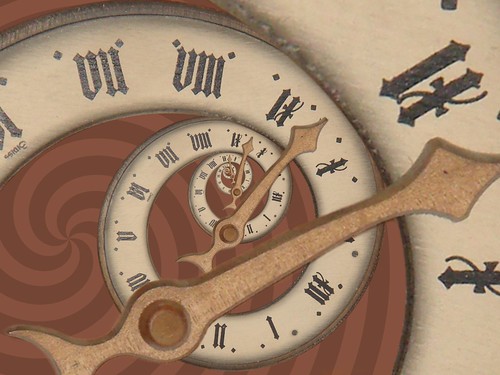
    Time Spiral by gadl
    I have what some might call an obsession with knowing when in time things took place, as I've mentioned once or twice. This applies in reading and in stories people tell me. I'm fine with stories told in non-linear fashion, as long as the timeline works and I can place where in it I am. It drives the coconspirator a little mad, sometimes, since when he tells stories I constantly ask him when something happened. I think it's important in placing events and experiences in the necessary context, knowing what happened before and what after, what might have caused what or what influenced what, what might not have happened but for another thing preceding it, etc. I suppose I'm always trying to place things in a larger context in one way or another in order to fully understand their significance. Timelines are essential in stories.

    Am I the only one? Does anyone else share this strange issue? What are some of your issues with stories and story-telling?
    Related Posts Plugin for WordPress, Blogger...